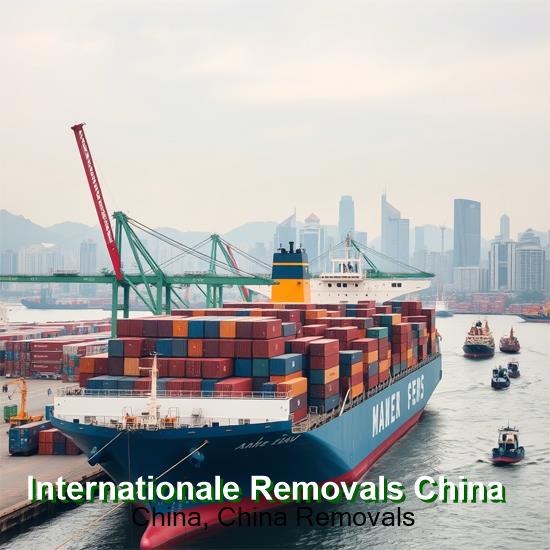
Which terminal your goods arrive at decides how far the lorry drives afterwards, and in a country this size that road leg can be a rounding error or it can be a thousand kilometres. It is the routing question worth asking before you accept any quote.
One vetted mover from our network chooses the entry point, and international movers who know China will explain the choice rather than present it. It shapes the packing plan and the relocation timetable both. The wrong terminal for your city is the most common way a quote quietly grows.
China has three kinds of entry point for household goods: deep sea container terminals on the coast, river terminals up the Yangtze, and rail terminals inland served from Europe.
The coast is served by a manageable number of very large terminals, and knowing which one covers your destination tells you most of what you need.
Shanghai, at Yangshan and Waigaoqiao, serves the city itself plus the whole Yangtze Delta: Suzhou, Kunshan, Wuxi, Nanjing, Hangzhou and Nantong. It clears faster than almost anywhere.
Ningbo, at Beilun, is the alternative delta gateway and the largest port in the world by cargo tonnage. It also serves Hangzhou, Wenzhou and Yiwu.
Shenzhen, at Yantian, Shekou and Chiwan, covers the eastern Pearl River Delta including Dongguan and Huizhou.
Guangzhou, at Nansha, covers the western delta: Foshan, Zhongshan, Zhuhai and much of Dongguan.
Qingdao, at Qianwan, is Shandong's gateway and serves Jinan inland.
Tianjin, at Xingang, is the northern hub and the clearance point for Beijing as well as its own city.
Dalian, at Dayaowan, serves the whole north east including Shenyang, Changchun and Harbin. Yingkou is a useful closer alternative for Shenyang and Changchun.
Xiamen, at Haicang and Dongdu, covers Fujian alongside Fuzhou at Mawei.
The Beibu Gulf, principally Qinzhou, serves Nanning and is far closer to it than Guangdong is.
Others include Zhuhai at Gaolan, Shantou at Guang'ao, and Hainan's own terminals at Haikou and Yangpu, reached across the strait.

The domestic portion of a Chinese delivery ranges from negligible to substantial, and it is the single largest reason two quotes for the same volume can differ. Ask for it as a separate line.
Minimal addition
Shanghai, Ningbo, Shenzhen, Qingdao, Xiamen, Dalian and their neighbours.
A noticeable line
Beijing, Jinan, Suzhou, Hangzhou, Nanjing and similar.
A substantial figure
Chengdu, Chongqing, Xi'an, Kunming, Harbin. Compare rail here.
Tell us your destination city and we will tell you which terminals can serve it and what each routing would cost.
We match you with your vetted mover, which means one team handles the whole relocation. It is free, with no obligation. Get a quote today and hold your dates.
Send your move detailsCall 07551 855 064 or +447551855064. Message us on WhatsApp.
Several destinations can be served by more than one terminal, and having that choice is worth money because it improves your odds of catching the sailing week you need.
The Yangtze Delta can use Shanghai or Ningbo. The two are close enough that either can serve Suzhou, Wuxi, Hangzhou or Nantong, and the Hangzhou Bay Bridge connects them.
Hangzhou sits almost equidistant from both and should always be priced against each.
The Pearl River Delta can use Shenzhen or Guangzhou depending on which side of the estuary your address sits. Since the Shenzhen to Zhongshan link opened, the western delta cities have realistic access to both.
Shenyang and Changchun can use Dalian or Yingkou, with Yingkou considerably closer. It rarely appears on a quote unless you ask.
Nanning should use the Beibu Gulf rather than Guangdong, which is roughly four times further. Habit sends a lot of southwest bookings the long way.
Inland cities generally can compare a sea and road routing against a rail one, and for the deepest destinations rail frequently wins once the road leg is counted honestly.
The question to put to any mover is simple. Which terminal, why that one, and what does the port to door portion cost as a separate figure. A firm that answers all three clearly is a firm that has actually looked.
The terminal and the mode are the same decision, so it is worth reading the freight pages alongside this one.
A move usually means moving money too, whether that is a deposit on a Chinese flat or funds coming back the other way. We have helped customers with currency exchange in any currency through trusted partners for many years, and our partners can help with the money side of your move. Mention it on the form and it gets included.
Experts in currency exchange
No hidden fees
5 star consumer ratings
Competitive exchange rate
It depends on your destination. Shanghai and Ningbo serve the Yangtze Delta, Shenzhen and Guangzhou the Pearl River Delta, Qingdao serves Shandong, Tianjin serves Beijing and the north, Dalian serves the north east, and Xiamen and Fuzhou cover Fujian.
Because it decides how far the lorry drives afterwards. For a coastal city that is a short and cheap leg. For an inland city it can be over a thousand kilometres, and that is the single largest reason two quotes for the same volume differ.
Tianjin, at Xingang, about a hundred and forty kilometres east. Beijing is landlocked, so all household goods bound for the capital clear at Tianjin and finish the journey by road. Many movers tranship into a smaller vehicle at a Beijing depot.
Often yes, and it is worth asking. The Yangtze Delta can use Shanghai or Ningbo, the Pearl River Delta can use Shenzhen or Guangzhou, and Shenyang can use Dalian or the closer Yingkou. Two options improve your chances of catching the right sailing week.
Three options. A long road leg from the coast, a river leg up the Yangtze for Nanjing, Wuhan or Chongqing, or European rail direct to an inland terminal. For the deepest destinations rail frequently wins once the road leg is counted honestly.
Chongqing, Chengdu, Xi'an, Zhengzhou, Wuhan, Yiwu, Changsha, Hefei, Jinan, Shenyang, Harbin and Kunming among others. The strongest cases are the ones furthest from a coast, since rail removes the domestic leg entirely.
Yes, Haikou's own terminals and Yangpu on the west coast. There is no bridge to the island, so goods either sail directly to a Hainan port or clear on the mainland and cross the strait by ferry, which adds a stage and some weather risk.
Usually sailing frequency. A more distant port with a service in the week you need can beat a nearer one with nothing suitable. That is a legitimate reason, but you should be told it is the reason rather than left to assume proximity.
Three things. Which terminal, why that one rather than a nearer alternative, and what the port to door portion costs as a separate figure. A mover who answers all three clearly has actually looked at your route rather than applied a default.
Send your collection address, your Chinese destination, a rough idea of the volume and your date. A vetted mover from our network checks the route, the paperwork and the access, then comes back to you with the price.
Send your move detailsWe match international moving enquiries with vetted moving companies in the AGM Group network, each holding FIDI FAIM certification and BAR Overseas membership.
We are not a removal firm ourselves. We find you the one that suits your route, and you deal with them directly from there.