15
Years in international removals
850k+
Verified customer enquiries
3
FIDI-accredited partners
Trusted International Moving Network
Accredited Relocation Specialists


You pay for the space your goods occupy and share the container with other people's shipments. That is the whole idea. It costs considerably less than a box of your own and it asks one thing in return, which is patience.
One vetted mover from our network handles the booking, matched for Chinese groupage traffic. What separates firms here is how often they consolidate, because that decides how long your goods sit waiting.
International movers price this by cubic metre. Your goods are measured, collected, taken to a consolidation depot, and loaded into a container alongside other loads bound for the same Chinese port. Most relocation budgets start here.

Understanding the stages explains both the price and the timing.
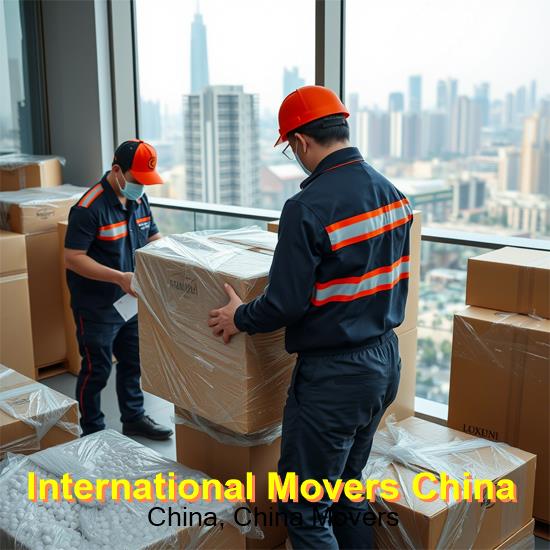
Collection. The crew arrives, wraps and loads your goods into a vehicle. Nothing is sealed because the shipment is not yet in a container.
Consolidation. Your load goes to a depot where shipments bound for the same Chinese port are gathered. It is measured properly here, and the cubic metre figure on your invoice is confirmed at this point rather than at the survey.
Loading. When enough volume has gathered, everything is loaded into a container and it sails. This is the waiting stage, and it is the reason nobody can give you a firm date at booking.
Deconsolidation. At the Chinese end the container is unloaded at a depot and shipments are separated back out.
Delivery. Your goods go out on a local vehicle to your address.
That is four handling stages more than a sole use container, which is why groupage carries a slightly higher risk of a scuff or a mislaid carton and why good labelling matters more than people think. Number every box, keep a list, and put your name and destination city on each one.
On the volume measurement. Your goods are measured as they sit, including the space around awkward shapes, so a bicycle or a garden table occupies more cubic metres than its own bulk. If a quote and a final invoice differ, this is usually why.
Groupage is priced per cubic metre, so the figure scales with what you actually ship. That makes it easy to control: every item you leave behind comes straight off the bill, which is not true of a sole use container.
£700 to £1,600
Personal effects, a bedroom, or someone furnishing a let flat.
£1,300 to £2,900
A one bedroom flat or a couple's belongings with some furniture.
£2,400 to £4,200
A two bedroom flat. Above this, price a whole box as well.
Tell us roughly what you are shipping and how flexible your dates are. Those two answers decide whether sharing is right for you.
We match you with your vetted mover, which means one team handles the whole relocation. It is free, with no obligation. Get a quote today and hold your dates.
Send your move detailsCall 07551 855 064 or +447551855064. Message us on WhatsApp.
Since your goods travel alongside strangers' belongings and get handled several extra times, a few habits make a real difference.
Label everything twice. Your surname and destination city on the top and on one side of every carton. Depot staff read whatever face is towards them, and a box with one label lying face down is a box that gets set aside.
Number the boxes and keep the list. One to sixty, with a note of what is in each. It takes an hour and it makes any query at either end solvable in minutes rather than days.
Pack for handling, not for the journey. The sea crossing is the gentle part. The lifting, the stacking and the depot movements are where damage happens, so cartons should be full and firm rather than half empty and crushable.
Dismantle what you can. A bed frame in pieces occupies a fraction of the space of one left assembled, and you are paying by cubic metre. The same goes for table legs and flat pack furniture.
Be honest about the inventory. Your list feeds the customs declaration and a vague entry slows the whole container, not just your part of it. That is a genuine consideration in shared shipping that does not arise with a box of your own.
Ask when the next consolidation sails. Not what the transit time is, but when the container is expected to close. That is the number that decides your actual arrival.
Worth comparing against a whole box and against sending boxes only.
A move usually means moving money too, whether that is a deposit on a Chinese flat or funds coming back the other way. We have helped customers with currency exchange in any currency through trusted partners for many years, and our partners can help with the money side of your move. Mention it on the form and it gets included.
Experts in currency exchange
No hidden fees
5 star consumer ratings
Competitive exchange rate
Less than container load, which is the trade term for shared container space. Your goods travel alongside other shipments in the same box and you pay for the cubic metres you occupy. The opposite is FCL, or full container load, where the whole container is yours.
By cubic metre. Your goods are measured as they sit, including the space around awkward shapes, so a bicycle or a garden table takes up more volume than its own bulk suggests. Every item you leave behind comes straight off the bill.
Because the container sails when it has enough volume in it. That wait can be a few days or a few weeks depending on how busy the route is. Ask when the next container is expected to close rather than what the transit time is, because that is the number that matters.
Four stages more than a whole container: into a consolidation depot, into the container, out at the far end, and out of the destination depot. That is why labelling matters more and why the risk of a scuff or a mislaid carton is slightly higher.
Around fifteen cubic metres is the usual crossover, though it depends on the route and the season. Above that, price both. A sole use box also gives you a fixed sailing date, which is worth something if your timing is not flexible.
Surname and destination city on the top and on one side of every carton, and number them with a list of what is in each. Depot staff read whichever face is towards them, so a single label lying face down is how boxes get set aside.
It can. Quotes are often estimated at survey and confirmed by measurement at the consolidation depot. Ask whether your figure is an estimate or a measurement, and what happens to the price if the two differ, before you book.
It is workable with proper packing, but a sole use container is safer because it removes four handling stages. For genuinely valuable or highly fragile pieces, either crate them properly or consider whether a whole box is the better answer.
In principle yes, since you share a container and a customs entry point. In practice it is uncommon, but it is worth asking a mover how they handle it, because it is a risk that simply does not exist with a container of your own.
Send your collection address, your Chinese destination, a rough idea of the volume and your date. A vetted mover from our network checks the route, the paperwork and the access, then comes back to you with the price.
Send your move detailsWe match international moving enquiries with vetted moving companies in the AGM Group network, each holding FIDI FAIM certification and BAR Overseas membership.
We are not a removal firm ourselves. We find you the one that suits your route, and you deal with them directly from there.