15
Years in international removals
850k+
Verified customer enquiries
3
FIDI-accredited partners
Trusted International Moving Network
Accredited Relocation Specialists


A domestic move puts your things in a van, drives an hour and takes them out again. A Greek move puts them through a warehouse, a container, a port, a customs check, a road leg and quite possibly a boat. Packing that copes with the first will not cope with the second.
That is the whole case for paying for proper packers on this route. It is not about saving you an afternoon. It is about how many times your things get picked up and put down between your old door and your new one.
Tell us what you have and you are connected with a vetted moving company from our network that packs to export standard for Greece.
Three levels exist. Full packing, where the crew does everything. Part packing, where they handle the fragile and awkward items and you do the books and clothes. And owner packed, where you do it all and they load. Each is priced differently, and each carries different consequences if you ever need to claim.

Insurance often treats owner packed cartons differently in a claim. An inventory is needed for customs whichever you choose, and dismantling beds, wardrobes and units is usually included on a full pack.
Greek and British customs both want to know what is in the shipment. On a move into Greece that means a detailed list of the personal belongings you are importing, and on a move into Britain it forms part of your relief application.
Crews packing to export standard build that list as they work, box by box, so the inventory and the physical packing match. Owner-packed shipments frequently do not have that, which is why they get more attention at clearance and why an unexplained sealed box is worth avoiding.
That list feeds your relief application, so it is worth getting right before your relocation certificate is issued. Grouping is allowed and sensible. You do not list every book and every shirt. You list the groups, clearly enough that somebody opening a box is not surprised by what is in it.
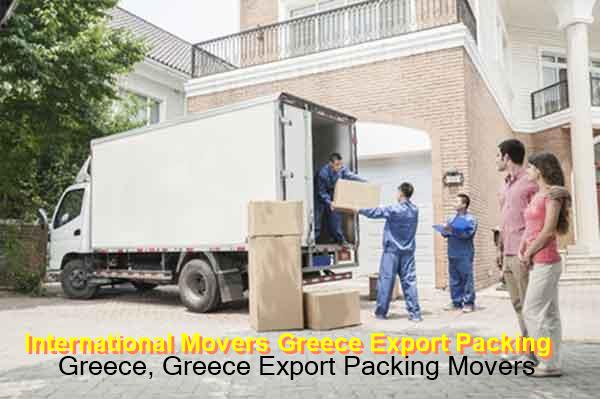
Most of a household is straightforward. A handful of things are not, and they are almost always the things people are most upset about if they arrive damaged.
Flat, fragile and easy to lean against something. They should be in purpose-made cartons, corner protected, and never travel loose against a container wall.
Weight, humidity and temperature all matter. A container crossing the Mediterranean in August is a different environment from a British living room, and instruments should be crated rather than wrapped.
Table tops and worktops crack along their own weakness under vibration. They need to travel on edge, crated, and it is worth asking whether they are genuinely worth shipping at all.
Original boxes if you still have them, purpose cartons if not. Large televisions travel badly flat and should be upright. Note serial numbers for the inventory.
Insurance on international shipments commonly distinguishes between goods packed by professionals and goods packed by their owner. Where you packed a box yourself and it arrives with something broken inside, cover can be narrower or excluded altogether.
That is not a reason to feel pushed into a full pack. It is a reason to ask the question directly before choosing, and to be told in writing what the difference is on your policy rather than assuming it works the way domestic cover does.
If you do pack yourself, pack properly. Cartons filled to the top, nothing rattling, heavy items in small boxes, and nothing sealed that you would not be comfortable opening in front of a customs officer.
Full unpacking, where the crew takes everything out and removes the debris, is a separate service and worth pricing. On a Greek delivery there is a practical reason beyond convenience: packing materials are bulky, and disposing of a container's worth of cartons from an Athens apartment is genuinely awkward.
Partial unpacking, where they reassemble furniture and place the boxes in the right rooms without emptying them, is the middle option and the one most people choose.
Worth reading before you decide to pack it yourself to save money.
Yes, and plenty of people do. Be aware of two consequences. Insurance often treats owner packed cartons differently from professionally packed ones, sometimes excluding damage inside a box you sealed. And your inventory has to be accurate enough for customs, which is easier when a crew logs it as they pack.
Yes, and the difference is handling stages. A domestic move is one lift in and one lift out. A Greek move can be a warehouse, a container, a port, a road leg and sometimes a ferry. Ask how many times your goods will be handled and have the packing specified for that number.
Pictures, mirrors, marble and stone tops, pianos and other instruments, large glass, and anything of unusual value or shape. Crating costs more and it is the right answer for a small number of items rather than for a whole household.
It can. Goods may sit in a container or a yard in real heat at the Greek end. Candles, vinyl records, some adhesives and certain cosmetics do not come through it well. Flag anything heat sensitive when you book so it can be packed or routed accordingly.
They should. Cartons are numbered and logged against the room they came from, higher value items are noted separately, and you get a copy before the crew leaves. That inventory is not just for you, it feeds the customs documentation on both sides of the move.
It is worth pricing, for a reason beyond convenience. A container's worth of cartons and paper is bulky, and disposing of it from an apartment in Athens or a village house is genuinely awkward. Many people take partial unpacking, where furniture is rebuilt and boxes are placed but not emptied.
Tell us what you are moving, where from and where to, and flag anything fragile, valuable or heat sensitive. A vetted moving company from our network can price full, part and owner packed options against your actual route.
Get your free quoteWe are a free enquiry service and a Working Member of AGM Group. Packing enquiries go to a vetted moving company from that network which packs to export standard for this route. We do not carry out removals ourselves and we do not employ packing crews.
Ask for the packing to be written into the quote line by line. It is the part most often assumed and least often specified.
Written by Darren Benjamin, Founder, International Removals Companies.